


The Douglas Sea Scale is a scale which measures the swell of the sea and the height of the waves:
- Degree 0—no measurable wave height calm sea
- Degree 1—waves >10 cm. rippled sea
- Degree 2—waves 10–50 cm. smooth sea
- Degree 3—waves 0.5–1.25 m. slight sea
- Degree 4—waves 1.25–2.5 m. moderate sea
- Degree 5—waves 2.5–4 m. rough sea
- Degree 6—waves 4–6 m. very rough sea
- Degree 7—waves 6–9 m. high sea
- Degree 8—waves 9–14 m. very high sea
- Degree 9—waves >14 m. phenomenal sea

Waves are primarily caused by the wind and its action on the surface of the water. Their height depends on how long the wind has been blowing and also on the strength of the wind. Waves formed by the wind blowing locally are termed "sea". Waves formed by the wind blowing at a distance from the place of observation are termed "swell".
Some waves result from earthquakes or underwater seaquakes and on approaching shallow water they become abnormally high and begin to break with great violence causing enormous devastation and loss of life. They are termed "tsunami" and we will all remember the tragic waves caused my a seaquake near Sumatra on Dec 26th, 2004, which claimed the lives of nearly 300,000 people in South-East Asia.
The following terms are frequently used in connection with waves:
- the length of a wave, that is the horizontal distance from crest to frest or trough to trough. If the distances between the crests of waves are far apart, the sea is termed "a long sea". When the crests are close together the sea is termed "a short sea", like for example in the Baltic Sea.
- the height of wave, that is the vertical distance from trough to crest.
- the period of a wave, that is the time between the passages of two successive wave crests or troughs past a fixed point.
- the velocity of a wave, that is the rate at which the crest travels.
| Beaufort number (force) | Wind Speed | Wave height (feet) | WMO* description | Effects observed on the sea | Effects observed on land | |
|---|---|---|---|---|---|---|
| knots | mph | |||||
| 0 | under 1 | under 1 | - | Calm | Sea is like a mirror |  |
| 1 | 1 - 3 | 1 - 3 | 0.25 | Light air | Ripples with appearance of scales; no foam crests | |
| 2 | 4 - 6 | 4 - 7 | 0.5 - 1 | Light breeze | Small wavelets; crests of glassy appearance, not breaking |  |
| 3 | 7 - 10 | 8 - 12 | 2 - 3 | Gentle breeze | Large wavelets; crests begin to break; scattered whitecaps |  |
| 4 | 11-16 | 13-18 | 3½ - 5 | Moderate breeze | Small waves, becoming longer; numerous whitecaps |  |
| 5 | 17-21 | 19-24 | 6 - 8 | Fresh breeze | Moderate waves, taking longer form; many whitecaps; some spray |  |
| 6 | 22-27 | 25-31 | 9½-13 | Strong breeze | Larger waves forming; whitecaps everywhere; more spray |  |
| 7 | 28-33 | 32-38 | 13½-19 | Near gale | Sea heaps up; white foam from breaking waves begins to be blown in streaks |  |
| 8 | 34-40 | 39-46 | 18-25 | Gale | Moderately high waves of greater length; edges of crests begin to break into spindrift; foam is blown in well-marked streaks |  |
| 9 | 41-47 | 47-54 | 23-32 | Strong gale | High waves; sea begins to roll; dense streaks of foam; spray may begin to reduce visibility |  |
| 10 | 48-55 | 55-63 | 29-41 | Storm | Very high waves with overhanging crests; sea takes white appearance as foam is blown in very dense streaks; rolling is heavy and visibility is reduced |  |
| 11 | 56-63 | 64-72 | 37-52 | Violent storm | Exceptionally high waves; sea covered with white foam patches; visibility further reduced |  |
| 12 | 64 and over | 73 and over | 45 and over | Hurricane | Air filled with foam; sea completely white with driving spray; visibility greatly reduced |  |
The weather is the state of the atmosphere with refference to wind, temperature, state of the sea, cloudiness, precipitation, atmospheric pressure, humidity, mist, fog, ice conditions.
It is important for seaman to understand all phenomena conected with the weather and to be able to read weather maps and listen to the weather forecast and report weather conditions at sea such as visibility and the direction of wind and its force according Beaufort Wind Scale.
Winds
Winds are mainly caused by a difference of temperature which in turn is sometimes responsible for the differences of barometric pressure. The strength and speed of wind at any given time depend on the gradient of atmospheric pressure that is the rate at which pressure changes with distance.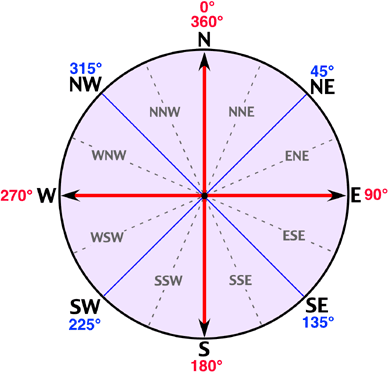
Speed of movement of pressure systems
Slowly: Moving at less than 15 knots
Steadily: Moving at 15 to 25 knots
Rather quickly: Moving at 25 to 35 knots
Rapidly: Moving at 35 to 45 knots
Very rapidly: Moving at more than 45 knots
Timing of gale warnings
Imminent: Within 6 hours of time of issue
Soon: Within 6 - 12 hours of time of issue
Later: More than 12 hours from time of issue
Terms referring to wind:
Backing - Indicates the changing of wind in the anticlockwise direction (i.e. from W to SW)
Becoming cyclonic - Indicates that there will be considerable changes in wind direction across the path of a depression within the forecast area.
Wind direction - Indicates the direction from which the wind is blowing.
Veering - Indicates the changing of the wind in a clockwise direction (i.e. from SW to W)
Variable - Indicates the wind constantly changing the direction from which it blows.

Why are ice classes needed?
the Ship Classification Societies "ice class" has a fundamental basis on the safety of the ship hull and the essential propulsion machinery. The class defines sufficient installed power for a safe operation in ice covered waters. The classification also defines certain hull structure against certain level ice, which in the Baltic Sea conditions is defined using the first year ice definition. The classifications also defines the requirements for the propeller shaft as a minimum power for maintaining ship speed in a re-frozen (covered by e.g. brash ice) fairway navigation channel.
When the ice conditions became difficult, traffic restricions are imposed. The restrictions pertain to the availability of icebreaker assistance. Some of the restrictions are about safety independent of assistance standards; some are caused by the availability of icebreaker services. The traffic restrictions are based on Ice Class Rules.


- simplicity
- reliability of operation
- can easily unravel
- can grip objects in the node
Ice Navigation
The Baltic Sea freezes anually.
The two most heavily marine operated areas in the world where seasonal sea ice plays an important role in navigation are the Gulf of St. Lawrence in Canada and the Baltic Sea in Europe. In the Baltic Sea aproximetely 40 percent of the total amount of cargo turnover, about 700 milion tons, occurs during winter months. Tha Baltic Sea freezes anually and in some parts the ice season lasts up to 7 months, from November to May. For example, in the Gulf of Finland the average length of the ice season is 120 days outside St. Petersburg, and 30 days at the entrance of the gulf.
The ice conditions are mostly affected by two factors: the number of sub-zero days and the prevailing winds. The sum of sub-zero degree-days controls the ice growth and the amount of ice. The prevailing winds control drifting and ridging of an ice field.
Forming of an ice cover
An ice cover starts to form on water when the surfer temperature reaches freezing point. Fresh water freezes at 0 C and in sea water freezing point decreses with increasingly salinity. Thus freezing point in ocean water is about -1.8C, but in the brackish water of the Baltic Sea it is about -0.4C.
In the Gulf of Finland ice thickness is greatest in the eastern parts of the gulf and is about 50 cm in an average winter. The biggest obstacles to winter navigation are ridges which are normally thicker than the level ice and are difficult to penetrate. Channels with thick side ridges and thick brash ice in the middle are formed when the ice cover in the fairway is repeatedly broken and frozen. The side ridges make passing of other vessels very difficult. The keel heights of the ridges are normally a lot bigger than the sail heights. The side ridges may grow several metres thick and the brash ice layer in between may become up to one metre thick. Ridges also form when winds push ice together.
In the Baltic Sea area ice conditions are monitored on a daily basis. The Finnish Ice Service of the Institute of Marine Research issues ice charts and ice reports and produces ice drift forecasts. The daily ice chart and ice report include a description of current ice conditions and information about the icebreakers operational areas.
I found on Youtube a relevant movie of helicopter rescue operation on the sea.
Example of request helicopter by radiotelephone and sends the following urgency message on channel 14:
Pan-Pan, Pan-Pan, Pan-Pan.
Rescue centre Helsinki.
This is (name of vessel), (name of vessel), (name of vessel).
Mike Whiskey Yankee Alpha 3
Position: Latitude 59 40' North
Longitude: 024 00" East
One crew member badly injured.
REQUEST: Immediate helicopter assistance for transportation to hospital.
Over.
The answer could be:
Pan-Pan, (name of vessel).
This is Rescue Centre Helsinki
Pan-Pan received.
(name of vessel).
Rescue Centre Helsinki.
We are coming to your assistance.
We are sending a helicopter and doctor.
Helicopter ETA is 30 minutes.
Over.
When helicopter aproach:
(name of vessel)
This is helicopter pilot.
We are now 2 miles from your position.
Mantain a course 245 that will keep wind 30 on port bow. We will first lower the guide rope
Then a stretcher in order to pick up the patient.
Over.
Helicopter.
This is (name of vessel).
Understood.
I will keep wind 30 on port bow.
Landing party ready to receive you.
Over.

- All electrical equipment from light bulbs to radiators and heaters produce heat, which may cause fire without to need for a spark. Switch off electrical equipment when not in use, whenever possible. Be particularly careful in galleys and cargo holds. Do not allow light clusters or single lights to be buried in the cargo - always check after loading.
- Always keep fire doors closed to restrict the spread of flames and smoke.
- Education is, as always, the greatest aid to safety. During fire drills on board everyone must learn where fire-fighting equipment and lifesaving appliances are kept and how they work.
- Station bills. Each vessel should have a Fire Duty Station Bill posted in a visible place and every crew member should be clear about his role and duties in a fire emergency.
Of all disasters that can happen to a vessel at sea, fire is one of the most devasting. Marine fire incidents are very destructive and have been responsible for the loss of many lives. Ship fires are second only to shipwrecks when calculating casualities and total loss.
It can often be a single careless act that edangers the lives of all the crew. that is why every member of the crew has a part to play in preventing fires. This aplies not only to fire-fighting methods. There are a number of precautions crew members can take on a day-to-day basis to make the ship a safer place and prevent the break-out of fires. The main danger spots are machinery, galleys, accomodation and cargo spaces.
- Careless smoking is a common cause of fire on ships. Always put out cigarettes completely. Smoking and non-smoking areas must be clearly defined. Comply with no-smoking signs. No one should be allowed to smoke in a ship's hold or the engine-room.
- Cleanliness is important in all parts of the ship. Do not allow flammable waste to pile up or accumulate. This is a special risk in the engine room, where heated parts of the engine may give off sparks ingniting surrounding materials and where dirt, grease, raqs and cotton waste mights easily self-ignite, if they come in contact with each other.
- Keep oil away from hot surfaces which might ignite it - check that all feed pipes and joints are in good condition. Be careful when pumping oil to ready-use tanks - avid spillage or overflow which could lead to fire.
Subscribe to:
Comments (Atom)